
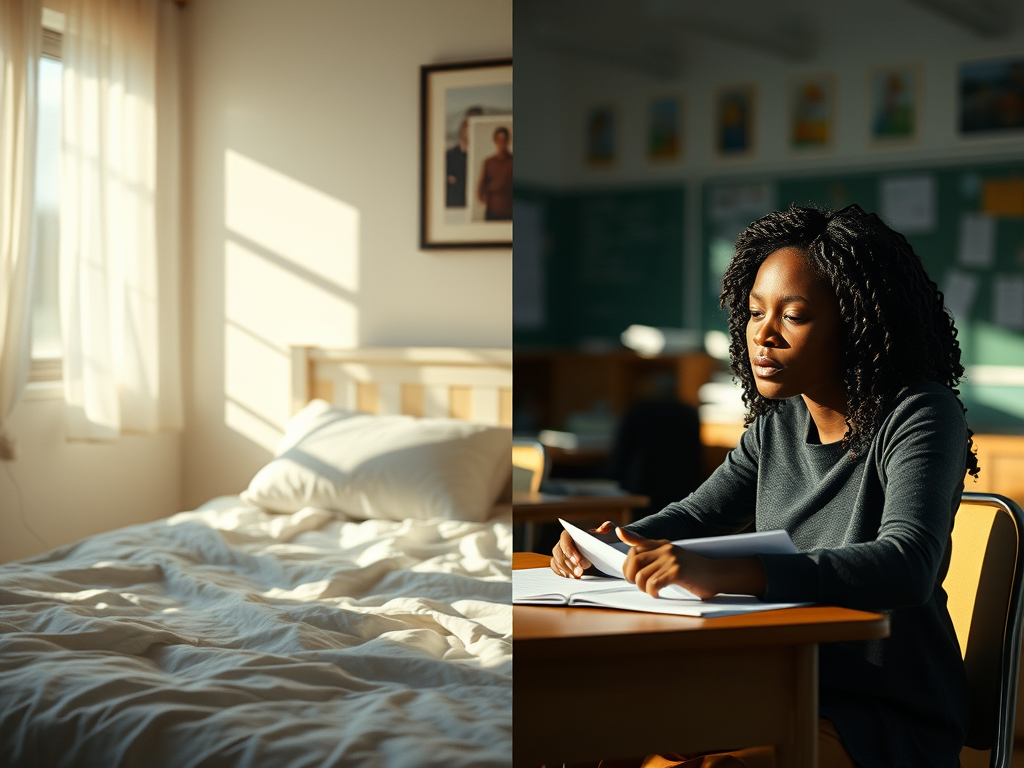
You got eight hours last night…
The bed was cozy, the room dark. Melatonin was taken on schedule. Every sleep hygiene rule was followed.
So why do you still feel like you’re running on fumes?
Welcome to mid-January, when the darkness outside mirrors the exhaustion inside. Teachers everywhere are finally naming what they’ve always suspected. Understanding rest beyond sleep for teachers might be exactly what your nervous system has been trying to tell you all along. Sleep matters, but it’s only part of the story.

When “Getting Enough Sleep” Isn’t Enough
To begin, let’s talk about what’s actually happening in classrooms right now. A 2025 survey from Prodigy Education found that 45% of K-12 educators viewed the 2024-25 school year as the most stressful of their entire careers. What’s even more concerning is that teachers were three times more likely to say this year has been harder than teaching during the height of COVID-19.
Read that again slowly. In other words, Harder than the pandemic.
The Research Behind Teacher Exhaustion
In previous posts, you’ve heard me share the following numbers, but they’re worth repeating because they explain exactly why you’re still exhausted, despite sleeping eight hours a night.
The University of Missouri released research in early 2025 showing 78% of public school teachers have thought about quitting since the pandemic. Meanwhile, data from RAND Corporation reveals that 60% of K-12 educators are experiencing burnout, with 62% reporting frequent job-related stress compared to just 33% of similar working adults.
This isn’t just, “I’m tired,” tired. Rather, it’s, “I slept for eight hours and still woke up exhausted,” tired.

The Rest Revolution Your Body Needs
Researchers from a 2025 meta-analysis published in BMC Public Health examined 10,196 adults across 54 studies. They discovered that improving sleep quality significantly reduced depression and anxiety symptoms compared to standard care.
The Neuroscience of Why Sleep Alone Isn’t Enough
Recent neuroscience research reveals why getting enough hours doesn’t always actually equate to feeling rested. During those seven to nine hours of consolidated sleep, your brain performs critical restorative functions.
Researchers at Cornell University discovered in 2024 that sleep allows certain parts of the hippocampus to go silent, enabling neurons to reset for new learning the next day. Additionally, during deep sleep, your brain, in fact, consolidates memories, repairs cells, regulates hormones, and clears waste products through this neuronal reset process.
However, your nervous system also needs micro-breaks during waking hours—something most teachers aren’t getting. A 2022 meta-analysis published in PLOS ONE examined 2,335 adults across 22 studies and found that these brief pauses lasting just minutes significantly boost vigor and reduce fatigue.
Teaching’s Impact on Your Stress Response
Teaching keeps your sympathetic nervous system activated almost continuously. Your sympathetic nervous system drives your “fight or flight” response—elevated heart rate, increased cortisol, heightened alertness. According to research published in StatPearls in 2024, the nervous system prepares your body to handle challenges by releasing stress hormones.
Brief moments of intentional rest activate your parasympathetic nervous system instead. This is what researchers call your “rest and digest” mode. When this system activates, your heart rate decreases, cortisol levels drop, and your body shifts into recovery mode. Without these micro-moments throughout your day, your sympathetic system stays chronically activated, even when you’re technically “resting” during prep period.
The 2022 PLOS ONE study also found that tasks requiring sustained focus and attention drain cognitive resources progressively. Taking brief breaks (even for just a few minutes) helps recharge these resources, improving subsequent performance and reducing errors.
Another 2024 study published in Advances in Computational Intelligence found that systematic 20-second micro-breaks after 7.5 minutes of cognitive work helped participants maintain stable performance and mitigate cognitive degradation.
Micro-Rest in Real Teaching Life
These moments don’t mean leaving your classroom or finding a yoga studio during lunch. Participants in workplace studies took breaks that included the following kinds of practices ~
- Brief breathing exercises lasting 60 seconds.
- Stepping away from screens to look at something distant.
- Short stretches during transitions.
- Simply closing their eyes for 20-60 seconds while students work independently, as well.
According to a 2022 systematic review published in Cogent Engineering & Design, active micro-breaks of 2-3 minutes every 30 minutes provided physical and mental health benefits without negatively impacting workplace productivity.
Your nervous system functions optimally with a quality nightly sleep that allows neuronal reset that is supplemented by intentional micro-moments of rest that shift you from sympathetic to parasympathetic activation throughout your teaching day.

What Rest Actually Looks Like (Beyond Your Pillow)
National Sleep Foundation research from 2025 found that 60% of American adults don’t get enough sleep. Furthermore, nearly 40% have trouble falling asleep three or more nights per week. Nevertheless, the most surprising finding wasn’t about sleep quantity.
People who felt satisfied with their rest were 45% more likely to be flourishing in life, regardless of exact sleep duration.
This is where rest beyond sleep for teachers becomes transformative. Rest isn’t just nighttime sleep. Similarly, it’s not just weekend recovery. It happens in the pause between breaths when you stop at your classroom door and take three deep inhales before entering the chaos.
Those two minutes when you close your eyes during lunch instead of scrolling through emails? That’s rest. And, rest is also the moment you notice the winter sun streaming through your classroom window, or when you actually let yourself feel grateful for five seconds without immediately jumping to the next task.

The Technology Trap Stealing Your Rest
A March 2025 study published in Frontiers in Psychiatry examined nearly 40,000 university students in Norway. The results stunned sleep scientists. Each one-hour increase of screen time after going to bed was tied to a 59% higher chance of having symptoms of insomnia. Correspondingly, students slept an average of 24 minutes less per night for every extra hour of screen use.
Another March 2025 study in JAMA Network Open looked at 122,058 adults across the United States and Puerto Rico. Compared with people who avoided screens before bed, those who used them had a 33% higher rate of poor sleep quality.
Why Your Phone Is Sabotaging Your Sleep
Think about your evening routine. After a brutal day of managing behaviors, differentiating instruction, and drowning in administrative demands, you collapse into bed with your phone. Understandably, you just want to scroll mindlessly for “a few minutes” before sleep.
Yet, unbeknownst to you, those few minutes are actually hijacking your rest.
Blue light from screens suppresses melatonin production. Likewise, the stimulating content keeps your nervous system activated. Screen use doesn’t just replace sleeping time through time displacement. It physiologically disrupts your body’s ability to enter restorative states, in the process.

The Yoga Nidra Secret ~ Rest Beyond Sleep for Teachers
A groundbreaking 2025 randomized controlled trial published in Stress and Health examined both 11-minute and 30-minute versions of Yoga Nidra meditation. Researchers found improvements in stress, anxiety, depression, rumination, sleep quality, and satisfaction with life. Most importantly, they measured actual changes in diurnal cortisol patterns, providing biological proof that rest practices work at a cellular level. The practice works by guiding your nervous system into a state between waking and sleeping.
Another 2025 systematic review published in the International Research Journal of Ayurveda and Yoga analyzed 15 randomized controlled trials. Physical benefits included reductions in blood pressure and improvements in heart rate variability. Mental outcomes showed decreased anxiety and depression. Emotional enhancement was observed across multiple studies.
What the Brain Science Shows
Another fascinating PLOS ONE study conducted in 2023 found that Yoga Nidra practice improved sleep quality by increasing the percentage of delta-waves in deep sleep. Additionally, all tested cognitive abilities improved, especially learning and memory-related tasks. Brain processing became faster, and accuracy increased.
This is rest beyond sleep for teachers in action. Yoga Nidra doesn’t require physical flexibility, expensive equipment, or hours of your time, whatsoever. Instead, it offers profound restoration through guided relaxation that you can practice lying down.
My Sunday Night Yoga sessions and Full Moon Prep experiences are specifically designed for teachers and provide this exact type of deep rest.
Offered every Sunday at 5pm PT/8pm ET (55 minutes) for just $11, these Sunday classes meet you exactly where you are. Similarly, Full Moon Prep experiences work with lunar cycles to enhance your natural rest rhythms. Full Moon Prep is offered on the eve of each full moon at 5pm PT/8pm ET (90 minutes) for just $37.

Have You Heard of Sleep Hygiene?
Scientists and researchers who study sleep have long emphasized that quality sleep depends on multiple factors working together, rather than just a consistent bedtime. Sleep hygiene includes room temperature, light exposure, pre-sleep routines, and nervous system regulation.
Sleep hygiene practices can include ~
- Dimming lights in the evening signals your body to begin melatonin production.
- Cooling the bedroom temperatures to between 60-67°F to optimize sleep architecture.
- Getting bright light exposure within 30 minutes of waking, which helps anchor your circadian rhythm, thus making it easier to fall asleep that night.
- And, during the day, avoiding caffeine after 2pm to protect your sleep architecture.
Practical Sleep Hygiene Strategies for Teachers
Sleep hygiene for teachers must account for your unique challenges. You can’t control the intensity of your teaching day. In effect, the constant decision-making, behavior management, and emotional regulation required from 8am to 3pm.
Unfortunately, generic sleep advice assumes you clock out from a typical job and naturally wind down. However, that isn’t your reality. And, as a result, teaching leaves your nervous system hyperactivated in ways other professions don’t. Therefore, sleep hygiene for teachers means helping your brain transition from that daytime intensity to nighttime rest.
First, create a wind-down ritual that starts at least one hour before bed. Screens should be dimmed, lights lowered, and calming activities embraced. Also, your bedroom should be cool and dark. And, white noise or earplugs can block disruptive sounds.
While this is a great foundation, the biggest sleep disruptor for teachers isn’t room temperature or noise. It’s notifications.
Silence email and ClassDojo notifications by 6pm at the latest. Your dermatologist isn’t answering patient texts at 8pm. Your physical therapist isn’t checking messages at 9pm. Other professionals maintain boundaries around their availability, and teaching should be no different. Setting your phone to Do Not Disturb mode protects both your sleep quality and your right to off-duty hours.

The Reality of Teaching Right Now
Teachers, you’re not failing because you’re tired in January. You’re human, navigating an education system that consistently demands more than any nervous system was designed to sustain.
So, while we continue to advocate for systemic change, you still need to survive this week. This day. This moment.
Your January Rest Prescription
Teacher wellbeing analysts consistently find that stress management practices make measurable differences. The good news? You can begin today, right where you are, without adding more to your plate. Start with just one practice. Choose something that feels doable rather than something you must perfect.
Simple Practices That Make a Difference
Try an 11-minute Yoga Nidra recording during your planning period. Plan for three mindful breaths before entering your classroom each morning. Put your phone on airplane mode one hour (at the very minimum) before bed. One non-negotiable moment of stillness becomes your daily anchor.
Above all, remember, rest beyond sleep for teachers isn’t selfish. Research from multiple studies confirms that teacher wellbeing directly impacts student outcomes. When you rest, you’re not abandoning your students. In actuality, you’re ensuring you have the capacity to show up fully for them.
Why Your Exhaustion Isn’t Personal Failure
This research illuminates something vital for teachers. You’re not suffering alone. Your exhaustion isn’t personal failure. The data confirms that teaching is currently unsustainable for many educators. Consequently, rest becomes not just self-care but an act of professional survival.
Furthermore, mid-January brings unique challenges. Holiday breaks provided temporary relief, but now the reality sets in. Spring break feels impossibly far away. The weather is dark and cold. Student behavior often deteriorates. Parent communication increases. Professional development days add even more requirements, on top of everything else.

Rest Beyond Sleep ~ How Your Body Naturally Heals
Your body is brilliantly designed. Given even brief opportunities, it naturally moves toward balance. The parasympathetic nervous system wants to activate. Cortisol levels want to regulate. Sleep architecture wants to optimize.
However, these natural processes require your cooperation. When you scroll through stressful news before bed, restoration gets blocked. Exhaustion deepens when you push through without breaks and deplete your reserves. Using weekends as catch-up time for unfinished work prevents genuine recovery.
Professional educators teach students about self-regulation, growth mindset, and resilience. Interestingly, applying these same principles to yourself requires recognizing that rest isn’t laziness. Research confirms that regular rest practices improve cognitive function, emotional regulation, and decision-making capacity.
Researchers studying Yoga Nidra found that even an 11-minute practice produced measurable benefits. Participants in experimental groups showed lower stress, higher wellbeing, and improved sleep quality after just 30 days. Effects remained stable at follow-up six weeks later.
This finding illustrates that rest beyond sleep for teachers doesn’t require massive time investments. Short practices work because they’re targeting your nervous system’s capacity for restoration, not trying to erase systemic problems through individual effort.

Making Rest Non-Negotiable
According to the 2025 RAND Corporation study, teachers work an average of 49 hours per week—down from 53 hours in 2024, but still approximately 10 hours beyond contracted hours. That’s significantly more than the 40-hour standard for most professions, with much of this extra work being uncompensated. What’s more, only 36% of teachers considered their base pay adequate compared to 51% of comparable working adults.
These systemic problems require systemic solutions. Nevertheless, while advocating for change, you still need strategies for today.
Setting Boundaries That Protect Your Energy
Protect your rest with the same fierceness you protect your students.
- Schedule rest appointments in your calendar.
- Set boundaries around evening and weekend work.
- Communicate these boundaries clearly to administrators and parents.
Explain to families that responding to emails within 24 hours (during school hours) ensures sustainable practice. Establish that parent communication happens during designated times only. And, make peace with the reality that perfect grading is impossible.
Because ultimately, rest beyond sleep for teachers means recognizing that you cannot pour from an empty cup. Research overwhelmingly confirms that exhausted teachers struggle to create engaging lessons or provide individualized support. Student achievement suffers when educators are depleted.
Your rest directly serves your students. Therefore, prioritizing restoration isn’t selfish indulgence. Rather, it’s professional responsibility.

The Truth About Mid-January Exhaustion
Your exhaustion is real. The overwhelm makes sense. This isn’t personal failure. It’s systemic dysfunction.
You’re a human being trying to perform an increasingly impossible job in an education system that consistently undervalues and overwhelms its teachers. Research confirms this reality. Studies document the stress, the burnout, the impossible demands.
Your Power Within Broken Systems
Despite the dysfunctional system, you have agency over how you respond. Understanding rest beyond sleep for teachers empowers you to make choices that support your nervous system even within broken systems.
- Sleep matters enormously. Protect it fiercely.
- Equally important are those micro-moments of rest throughout your waking hours. Discovering rest beyond sleep for teachers transforms how you approach each day.
- The pause between breaths.
- The stillness before entering chaos. That conscious choice to close your eyes for sixty seconds instead of scrolling.
- Yoga Nidra offers particularly powerful restoration because it works with your body’s natural capacity for deep rest.
- Sunday Night Yoga sessions and Full Moon Prep practices provide structured support for incorporating these rhythms into your life.
When you rest, you’re not abandoning responsibility. It’s more like you’re ensuring you have the capacity for meaningful contribution.

Ready to discover rest beyond sleep for teachers that actually restores your soul? Join thousands of educators finding that deep rest isn’t luxury ~ it’s survival. Subscribe to The Reset ~ Sunday Soul Care for Teachers for weekly strategies grounded in neuroscience and wisdom. Experience transformative restoration through Sunday Night Yoga sessions every week at 5pm PT/8pm ET for just $11. Your most sustainable teaching starts with sacred rest.
Bibliography
Albulescu, P., Macsinga, I., Rusu, A., Sulea, C., Bodnaru, A., & Tulbure, B. T. (2022). “Give me a break!” A systematic review and meta-analysis on the efficacy of micro-breaks for increasing well-being and performance. PLOS ONE, 17(8), e0272460. https://doi.org/10.1371/journal.pone.0272460
Chu, B., Marwaha, K., Sanvictores, T., Awosika, A. O., & Ayers, D. (2024, May 7). Physiology, Stress Reaction. In StatPearls. StatPearls Publishing. https://www.ncbi.nlm.nih.gov/books/NBK541120/
Connecticut Education Association. (2024, November 26). What’s causing teacher burnout? National Education Association. https://www.nea.org/nea-today/all-news-articles/whats-causing-teacher-burnout
Datta, K., Bhutambare, A., V. L., M., Narawa, Y., Srinath, R., & Kanitkar, M. (2023). Improved sleep, cognitive processing and enhanced learning and memory task accuracy with Yoga nidra practice in novices. PLOS ONE, 18(12), e0294678. https://doi.org/10.1371/journal.pone.0294678
Dianita, O., Kitayama, K., Ueda, K., & Nomura, A. (2024). Systematic micro-breaks affect concentration during cognitive comparison tasks: quantitative and qualitative measurements. Advances in Computational Intelligence, 4, 7. https://doi.org/10.1007/s43674-024-00074-6
Giridharan, S., Pandiyan, B., & Godbole, M. (2025). Effects of Yoga Nidra on physical, mental, and emotional health outcomes: A systematic review of randomized controlled trials. International Research Journal of Ayurveda and Yoga, 8(7), 69-76. https://journals.acspublisher.com/index.php/irjay/article/view/22479
Hjetland, G. J., et al. (2025, March 31). One hour’s screen use after going to bed increases your risk of insomnia by 59%, scientists find. Frontiers in Psychiatry. https://www.frontiersin.org/news/2025/03/31/hours-screen-use-after-bed-increases-insomnia-risk-frontiers-psychiatry
Karaba, L. A., Robinson, H. L., Harvey, R. E., Chen, W., Fernandez-Ruiz, A., & Oliva, A. (2024). A hippocampal circuit mechanism to balance memory reactivation during sleep. Science, 385, 738-743. https://doi.org/10.1126/science.ado5708
Mikhail, C., Cleworth, T., Healy, G. N., Johnson, N., Dempsey, P. C., & Phipps-Taylor, M. C. (2022). Effects of active microbreaks on the physical and mental well-being of office workers: A systematic review. Cogent Engineering & Design, 9(1), 2026206. https://doi.org/10.1080/23311916.2022.2026206
Moszeik, E. N., Rohleder, N., & Renner, K. H. (2025). The effects of an online Yoga Nidra meditation on subjective well-being and diurnal salivary cortisol: A randomised controlled trial. Stress and Health, 41(3), e70049. https://doi.org/10.1002/smi.70049
Moszeik, E. N., von Oertzen, T., & Renner, K. H. (2020). Effectiveness of a short Yoga Nidra meditation on stress, sleep, and well-being in a large and diverse sample. Current Psychology. https://doi.org/10.1007/s12144-020-01042-2
National Sleep Foundation. (2025). National Sleep Foundation’s 2025 Sleep in America® Poll. https://www.thensf.org/wp-content/uploads/2025/03/NSF_SIA_2025-Report_final.pdf
Pandi-Perumal, S. R., et al. (2022). The origin and clinical relevance of Yoga Nidra. Sleep and Vigilance, 6(1), 61-84. https://doi.org/10.1007/s41782-022-00202-7
Prodigy Education. (2025, June 6). Teacher stress levels have surpassed pandemic-era highs. eSchool News. https://www.eschoolnews.com/sel/2025/06/06/teacher-stress-levels-have-surpassed-pandemic-era-highs/
Reinke, W. M., et al. (2025). What a new survey says about teachers’ plans to leave their jobs. National Education Association. https://www.nea.org/nea-today/all-news-articles/what-new-survey-says-about-teachers-plans-leave-their-jobs
Research.com. (2025, November 7). Teacher burnout statistics for 2026: Challenges in K-12 and higher education. https://research.com/education/teacher-burnout-challenges-in-k-12-and-higher-education
Steiner, E. D., Levine, P. R., Doan, S., & Woo, A. (2025). Teacher well-being, pay, and intentions to leave in 2025: Findings from the State of the American Teacher Survey. RAND Corporation. https://www.rand.org/pubs/research_reports/RRA1108-16.html
Systematic review. (2025, September 1). A meta-analysis study evaluating the effects of sleep quality on mental health among the adult population. BMC Public Health. https://link.springer.com/article/10.1186/s12889-025-23709-w
Wooclap. (2025, June 17). Teacher burnout statistics in 2025: Causes, effects, and solutions. https://www.wooclap.com/en/blog/teacher-burnout-statistics/
Zhong, C., et al. (2025). Electronic screen use and sleep duration and timing in adults. JAMA Network Open, 8(3), e252493. https://doi.org/10.1001/jamanetworkopen.2025.2493
Leave a Reply